Training
and Visits
Much of my training
in Digital Theatre/Performance has come from experience (see experiments.
Through University of Maryland courses and independent study I've
picked up some skills in Final Cut Pro, Maya, and Jitter/Max. Additional
Training has come through summer workshops with Troika Ranch. This
summer I look forward to learning additional skills in Dance Technology
at University of Arizona and UC Irvine as well as presenting a conference
paper on Intercultural Digital Collaboration at ATHE in Toronto.
Read more about my discussions,
interviews and impressions in my visit
notes. |
New York production
of Alladeen
by Builders Association/motoiroti
In December I was able
to attend the New York staging of Builders Association and motoroti's
digital theatre production Alladeen. This intercultural work combined
spectacular digital video manipulation effects on the fly with themes
of globalization and virtual place. The story weaves together documentary
footage of the workers at global call centers in India and the Aladdin
myth. The workers are trained to impersonate American or British
citizens when assisting callers and must adopt Western names, accents,
and knowledge for which they are paid well for Indian standards.
The piece raises questions about the effects of globalization on
individuals, consumerism and instant gratification, and variable
identity. The show uses the metaphor of technology as well as the
digital staging technology to cast both the call center workers
as Aladdin characters, friends personas, wish granters and temporarily
into First World citizens. The work has been a key feature of several
of my recent papers and presentations.
To find out more about
the web site, music video, or stage show go to www.alladeen.com
I also checked in with
GSRT about their process and Troika Ranch saw some great slow motion
footage from Dawn & Mark's work in progress "Surfaces."
|
University of
Kansas -VR Lab
| Very recently,
I was thrilled to attend the opening night of The Magic Flute
at the University of Kansas, 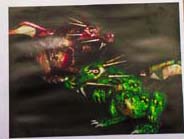 which
featured animated characters and scenic projections by technologist
Mark Reaney. It was a splendid production that surpassed my expectations.
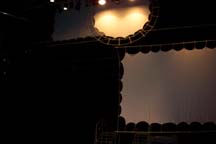
The sparse set, was in fact a bare stage back to the brick walls,
with the exception of the two rectangular and one circular rear-projection
screens (and the creatures of light and digital landscapes that
inhabited them) which at times made entrances and exits as grand
as any of the characters. They flew off the stage with the Queen
of the Night burst onto the stage with her circular screen illuminated
with electric sparks and fractal spirals of intense hues. They danced
across the stage with the feet of the pages which held make-shift
screens by poles, allowing the dragon to chase Prince Tamino through
the space, or as small hand carried structures allowing the round
little blue-bird to furtively mock Papagano and avoid his net. These
screens (and the magic of Mark Reaney and his skill with programs
such as 3D Max) showed the audience the magic of the flute as we
crossed through flames and water, the sun's rays, brought us into
a continually rotating Escher-like castle, a forest glade, the mysterious
realm of cyberspace, and even set us inside an ever-changing world
visually representing sound itself. which
featured animated characters and scenic projections by technologist
Mark Reaney. It was a splendid production that surpassed my expectations.
The sparse set, was in fact a bare stage back to the brick walls,
with the exception of the two rectangular and one circular rear-projection
screens (and the creatures of light and digital landscapes that
inhabited them) which at times made entrances and exits as grand
as any of the characters. They flew off the stage with the Queen
of the Night burst onto the stage with her circular screen illuminated
with electric sparks and fractal spirals of intense hues. They danced
across the stage with the feet of the pages which held make-shift
screens by poles, allowing the dragon to chase Prince Tamino through
the space, or as small hand carried structures allowing the round
little blue-bird to furtively mock Papagano and avoid his net. These
screens (and the magic of Mark Reaney and his skill with programs
such as 3D Max) showed the audience the magic of the flute as we
crossed through flames and water, the sun's rays, brought us into
a continually rotating Escher-like castle, a forest glade, the mysterious
realm of cyberspace, and even set us inside an ever-changing world
visually representing sound itself.
Before the matinee Mr.
Reaney was kind enough to give me a quick tour of backstage. The
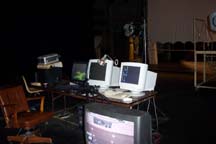
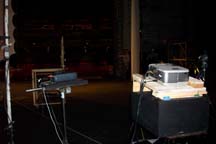
technical crew,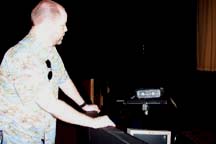 which remains visible in the background during production, has control
of real-time video recording, and computer animation controls for
both front and rear-screen projected elements. A controller sitting
in the orchestra pit can manipulate the humorous movements of the
whimsical and all too brief dragon. During the matinee, I noticed
several small changes from the night before in the sound visuals
and the dragon especially, demonstrating the ability of the technicians
to improvise and create real-time reactions to the audience and
the actors. The technicians became digital puppet masters. The cast
and crew did a marvelous job in bringing this story to life, and
all of them- both human and computer-generated, artists of sound
or light, deserved a curtain call and a standing ovation.
which remains visible in the background during production, has control
of real-time video recording, and computer animation controls for
both front and rear-screen projected elements. A controller sitting
in the orchestra pit can manipulate the humorous movements of the
whimsical and all too brief dragon. During the matinee, I noticed
several small changes from the night before in the sound visuals
and the dragon especially, demonstrating the ability of the technicians
to improvise and create real-time reactions to the audience and
the actors. The technicians became digital puppet masters. The cast
and crew did a marvelous job in bringing this story to life, and
all of them- both human and computer-generated, artists of sound
or light, deserved a curtain call and a standing ovation.
The following day, Mr.
Reaney got some well-deserved rest and I watched archival tapes
of previous productions such as Midsummer Night's Dream (also an
excellent production incorporating live actors and digital projections).
image/link |
| |
Gertrude Stein
Repertory Theatre
| In March
I had a chance to meet with Cheryl Favor and her staff/crew of both
Gertrude Stein Repertory Theatre and their for-profit company Learning
Worlds. The dedicated group works together during the day and makes
time for their driving passion for theatre after hours. This group
has been busy with the Glow Pack theater database a collaboration
with scholars at Cornell University and in St. Petersburg. I was fascinated
with their descriptions of previous works the Crucible Project and
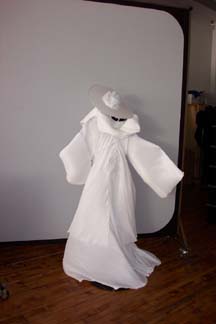
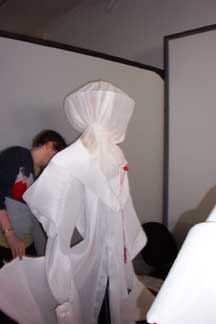
Ubu Roi, both multi-site projects, and by the stunning images created
in earlier works which layered projected performers on top of present
performers draped in sheets or holding fans. Their current project
Making of Americans, is an insightful exploration of Stein's examination
of perception and character. |
| |
Georgia
| The visit to University
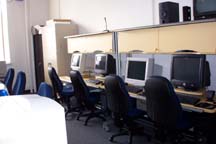
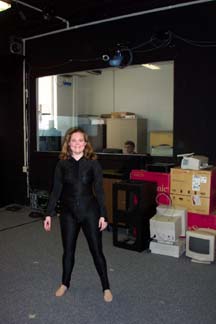
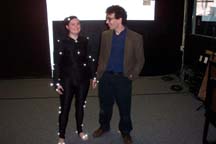
of Georgia was a wonderful experience. In brief, Georgia and Dr. David
Saltz and Allen Partridge have very impressive facilities (and staff)
"behind the glass door" which include motion capture facilities
several labs and staff dedicated to creating 3D animations for the
Virtual Vaudeville project. In addition to their past work on digital
theatre incorporating live actors and 3D character (Tempest), live
actors and interactive sensor-triggering environments (Kaspar) and
semi-live actors and media in interactive/performative environments
(Beckett Space).....Georgia has another very strong asset, ICE http://www.ice.uga.edu/html/
. Ideas for Creative Exploration is an inspiring example of a hub
for coordination and facilitation of interdisciplinary digital collaboration.
|
| |
Studio Z
| Studio Z in Chicago is
a exciting group which works with the improvisational techniques of
Second City and incorporates elements of Commedia del arte in their
modern tales of urban life and characters. Dan Zellner (http://www.studioz.org/persons/dzellner.htm)
heads the group which develops original material for performance in
front of a mobile rear-projection screen which makes digital performance
(and settings accessible to varied audiences. |
| |
Talking Birds
Recently, I visited
with The Talking Birds, a group which works on site-specific performances
which evolve out of thier fascination with community landmarks.
The group researches the buildings, gathers oral histories, and
devises new scripts to be performed in these found spaces in a way
which both draws on thier history and expands the audiences's sense
of the places' cultural meaning. I was able to observe the group
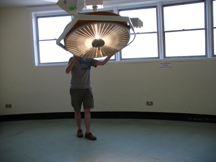
working on Three Doctors, a piece in an abandoned hospital
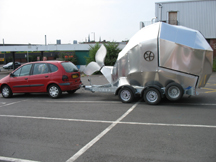
wing and as they rehearsed thier pagent piece (as Jonah) from inside
a giant metal whale. I also enjoyed participating as a phone voice
in one of thier recent projects.
www.talkingbirds.co.uk
|
| |
Visit Notes:
Read more about
my discussions, interviews and impressions in my visit
notes.
|